Why copper got more expensive, and what that does to your bottle
Copper passed 12,000 dollars a tonne for the first time in December 2025. Where that demand comes from, why supply does not follow, and why this plays out differently for a copper object than you would expect.
Written and source-checked by the Kopero editors · Updated October 27, 2026

The metal got more expensive, and that is no accident
In December 2025 copper passed 12,000 dollars a tonne for the first time, and in January 2026 it briefly touched 14,500. For a metal that has been mined for thousands of years that is remarkable, and it has little to do with speculation.
Below is where that demand comes from, why supply does not follow, and why this plays out differently for a copper object than for most things that get more expensive.
In short
- Electrification is the engine: power grids, electric cars, solar and wind farms and data centres all run on copper.
- The International Energy Agency expects demand to grow by up to 48% by 2040.
- The average ore grade of copper mines has fallen 40% since 1991: more and more rock has to be moved for the same tonne of copper.
- A new mine takes years, so supply cannot follow a spike in demand quickly.
- Copper is infinitely reusable without loss of quality, and that makes a copper object something other than a consumable.
Where the demand comes from
Everything that carries electricity asks for copper. Of all metals only silver conducts better, and silver is unaffordable for cabling. That makes copper the standard material for power grids, motors, transformers and wiring, and why that is so in physical terms is in why copper conducts.
In recent years new buyers have arrived, all knocking at once: grid expansion, electric cars, solar and wind farms, and lately data centres. The International Energy Agency allows for global copper demand growing by almost half by 2040.
Why supply does not follow
This is the real bottleneck. The average ore grade of copper mines has fallen 40% since 1991. That means moving almost twice as much rock for the same tonne of copper, and that costs energy, water and money.
On top of that, a new mine does not run next year. Between finding a deposit and the first delivery sit years of permits, financing and construction. When demand then accelerates, supply simply cannot keep up. Individual setbacks make it sharper: a landslide at Grasberg in Indonesia, one of the largest copper mines in the world, halted production well into 2026.
What that means for a copper object
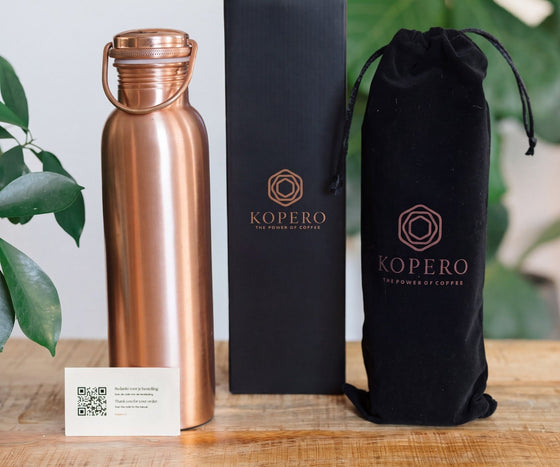
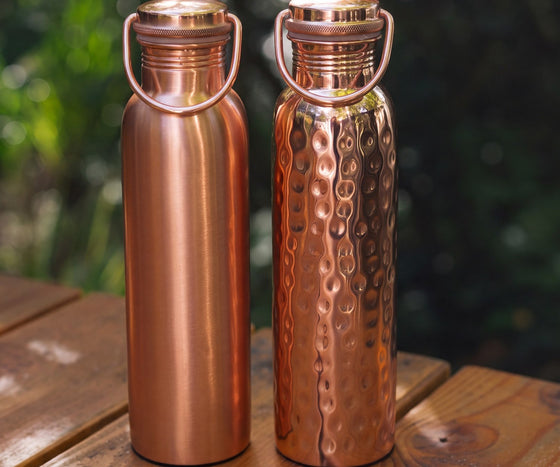
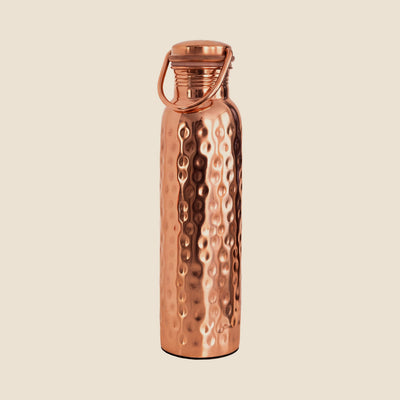
With a bottle, a jug or a bracelet, the metal is a real cost and not a detail. A 900 ml copper water bottle is 300 grams of solid copper, and that is exactly the material the world market is competing for. If the raw material gets more expensive, that carries through.
Solid copper, rather than a copper-plated core.
And now the pleasant part
With almost everything that gets more expensive, that value is gone the moment you use it. Not with copper. The metal is infinitely reusable without loss of quality: a large share of all the copper ever mined is still in circulation. The jug you buy today is still copper in fifty years.
Everything we sell is made from solid copper, rather than a thin copper layer over another metal. Its warm shine can develop a distinctive patina with use. You can let that patina grow or polish the shine back.
How copper compares with plastic and stainless steel, on this point too, is in the material comparison.
What we do about it
Solid copper, rather than a copper-plated core.
Have a look at the copper water bottle, the jug and the bracelet, or browse the full Kopero collection.